
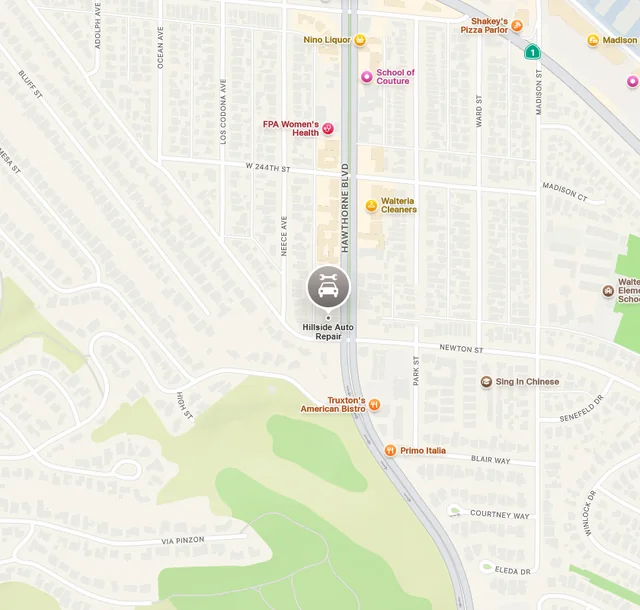

Your brakes are the one system you never want to guess about. Whether you're threading through stop-and-go traffic on Hawthorne Boulevard or coming down the hill from Rancho Palos Verdes, Rolling Hills, or Redondo Beach, your car has to stop the moment you ask it to. At Hillside Auto Repair, we inspect the entire braking system, show you exactly what we find with photos sent to your phone, and fix only what needs fixing. Torrance drivers have trusted us with their brakes since 1984.
Know your braking system
Most modern vehicles combine several braking technologies, and each one matters:
- Anti-lock brakes (ABS) keep the wheels from locking so you can steer while braking hard.
- Disc brakes on the front (and usually rear) wheels use pads that clamp a spinning rotor to create stopping force.
- Drum brakes, still found on some rear axles, press shoes outward against a drum to slow the car.
- The parking brake, mechanical or electronic, locks the rear wheels for parking and emergencies.
When any of these components wears down or misbehaves, the whole system's performance suffers, and it should be looked at right away.
Common signs you need brake repair
- Squeaking, squealing, or grinding when you brake
- A soft, spongy, or pulsing brake pedal
- Pulling to one side when you stop
- A brake or ABS warning light that stays on
- Longer stopping distances than you're used to
Symptoms like these can point to worn pads or shoes, damaged rotors, air or moisture in the brake lines, a fluid leak, or an ABS sensor issue. We diagnose the actual cause before replacing anything, so you pay to fix the real problem, once.
Complete brake service, all under one roof
Every brake job at Hillside starts with a full-system inspection, and we handle everything the system might need: replacing pads and shoes, resurfacing or replacing rotors, flushing brake fluid and inspecting the lines, ABS diagnostics and repair, parking brake adjustment, and master cylinder service. From an Acura's brake pads to a BMW's brake lines, we're equipped for every make we service, hybrids included.
When should you have your brakes inspected?
Once a year or every 12,000 miles is a healthy rhythm for most drivers, sooner if you tow, drive the hills, or spend your commute in traffic. Routine checks catch cheap problems before they become expensive ones. And remember: brake inspections here are free, and you get the photos either way.
Worth knowing: the ABS light means the anti-lock computer has stepped aside - your base brakes still work, but the safety net is off, so have it read soon. And many cars still run drum brakes in the rear, where the parking brake lives - one more reason 'brakes' is a system inspection, not a glance at pads.
Your local brake shop since 1984
We use quality parts, proper tools, and technicians who explain what they find in plain language. That's why generations of drivers across Torrance, Redondo Beach, Rancho Palos Verdes, Palos Verdes Estates, and the wider South Bay bring their brakes to Hillside, and why every repair leaves with a written warranty.
Watch: How Disc Brakes Work
A short animation, no narration, showing the thing almost nobody pictures correctly: how a single hydraulic piston on one side of the rotor manages to squeeze both pads against the disc. It builds the whole assembly up in front of you - the hub, the vented rotor, the caliper, and the pad layer by layer, including the shim that keeps the brakes quiet and the underlayer that stops heat from reaching the caliper. If you have ever wondered what you are actually paying for when we quote pads and rotors, this is three minutes well spent. Watch for the part about the clips and hardware being replaced along with the pads. That is why they appear on your estimate.

Video by No User Serviceable Parts on YouTube. Hillside Auto Repair is not affiliated with this channel. Watch on YouTube.